


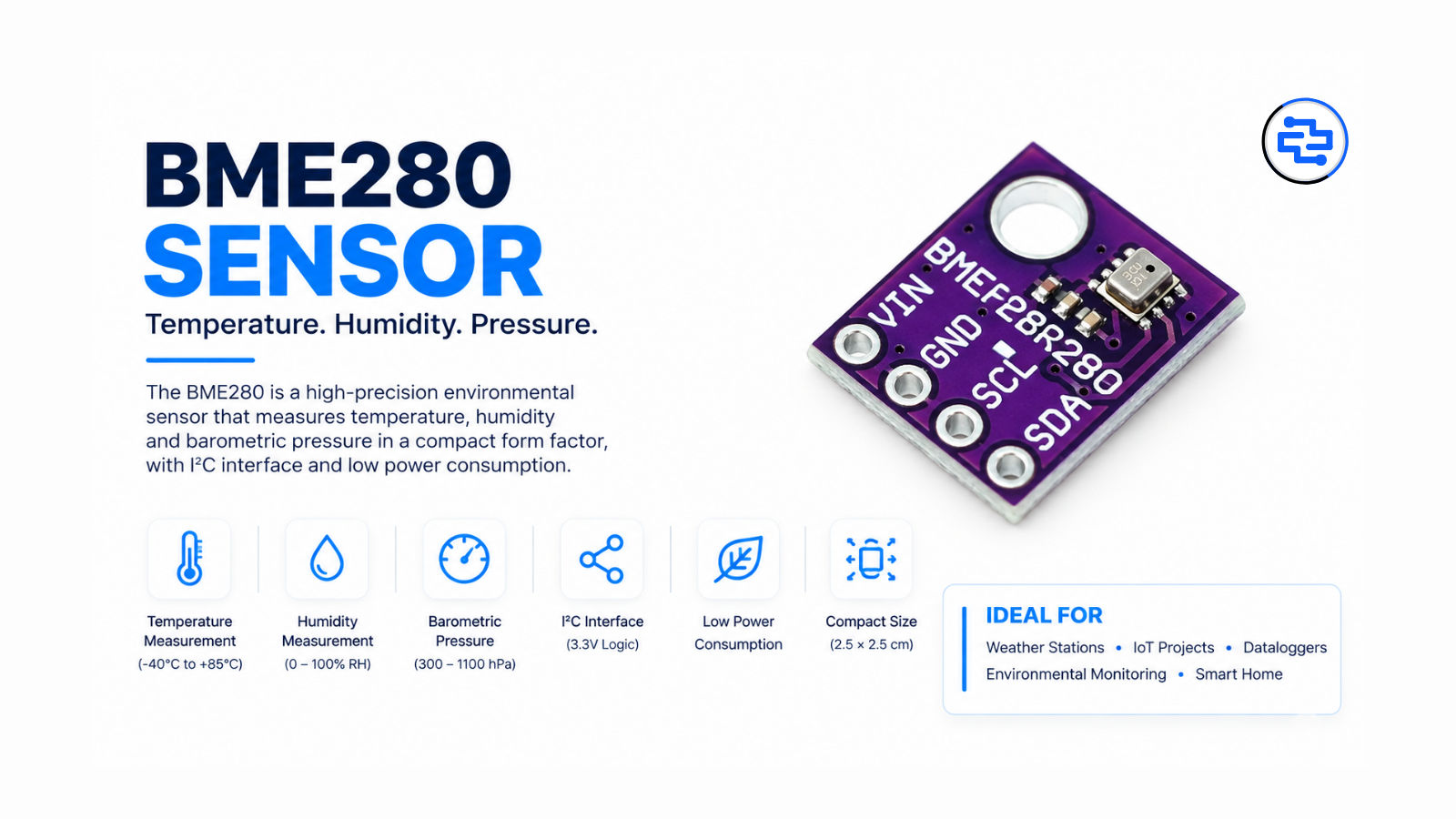
BME280 Sensor Module – Temperature, Humidity & Pressure | Directronics
Learn what the BME280 Sensor Module is, how it measures temperature, humidity, and atmospheric pressure, and how to use it with Arduino and ESP32. Explore its key features, specifications, applications, communication interfaces, and BME280 vs BMP280 comparison.
BME280 Sensor Module – Temperature, Humidity & Pressure Sensor
The BME280 Sensor Module is a compact digital environmental sensor used to measure temperature, relative humidity, and atmospheric pressure. Its small size, low power consumption, and support for common digital communication interfaces make it a popular choice for Arduino, ESP32, Raspberry Pi, IoT, weather monitoring, and automation projects.
Unlike a basic temperature sensor, the BME280 provides three important environmental measurements from a single sensor, making it useful for projects where monitoring surrounding conditions is important.
What is the BME280 Sensor?
The BME280 is a digital environmental sensor developed by Bosch Sensortec. It combines temperature, humidity, and barometric pressure sensing in a single compact device.
The sensor communicates with a microcontroller or development board using I²C or SPI, allowing it to be integrated into platforms such as Arduino, ESP32, Raspberry Pi, and other embedded systems.
The BME280 is particularly useful for applications that require environmental monitoring, weather data, altitude estimation, or indoor climate monitoring.
Key Features of BME280
The BME280 offers several features that make it suitable for compact embedded and IoT applications:
Measures temperature, humidity, and atmospheric pressure
Digital sensor with I²C and SPI communication
Temperature operating range of approximately -40°C to +85°C
Pressure measurement range of 300 to 1100 hPa
Humidity measurement from 0% to 100% RH
Low power consumption
Compact sensor package
Configurable measurement and oversampling options
Suitable for Arduino, ESP32, Raspberry Pi, and other microcontrollers
Useful for weather stations, IoT devices, automation, and environmental monitoring
BME280 Specifications
Parameter | BME280 |
|---|---|
Sensor Type | Temperature, Humidity & Pressure |
Temperature Range | -40°C to +85°C |
Humidity Range | 0–100% RH |
Pressure Range | 300–1100 hPa |
Humidity Accuracy | ±3% RH |
Interface | I²C / SPI |
Operating Voltage of Sensor IC | 1.71–3.6 V |
I²C Speed | Up to 3.4 MHz |
SPI Speed | Up to 10 MHz |
Package | 2.5 × 2.5 × 0.93 mm LGA |
Note: Specifications of a complete BME280 breakout module can vary depending on the module manufacturer, especially its regulator, logic-level circuitry, connector layout, and pinout.
How Does the BME280 Work?
The BME280 contains sensing elements for three environmental parameters.
1. Temperature Measurement
The BME280 measures ambient temperature and provides the result digitally to the connected microcontroller.
Temperature data can be used for applications such as:
Room temperature monitoring
Weather stations
Electronics enclosure monitoring
IoT environmental sensors
Smart home systems
2. Humidity Measurement
The humidity sensor measures relative humidity, which indicates the amount of moisture present in the air compared with the maximum amount the air can hold at a particular temperature.
Humidity monitoring is useful in:
Indoor climate monitoring
Greenhouses
Storage environments
Weather stations
Smart home projects
IoT monitoring systems
3. Atmospheric Pressure Measurement
The BME280 also measures barometric pressure. Changes in atmospheric pressure can be used for applications such as weather monitoring and approximate altitude estimation.
This makes the BME280 useful for:
Weather stations
Altitude measurement
Indoor floor detection
Outdoor monitoring
Drones and robotics projects
IoT environmental devices
BME280 Communication Interfaces
The BME280 supports two common digital communication protocols:
I²C
I²C is commonly used when connecting the BME280 to Arduino, ESP32, Raspberry Pi, and similar development boards.
It requires two communication lines:
SDA – Data
SCL – Clock
This makes I²C convenient when multiple sensors need to share the same communication bus.
SPI
The BME280 also supports SPI communication. SPI can be useful when higher-speed communication or a dedicated sensor connection is preferred.
The exact wiring depends on the BME280 breakout board being used.
BME280 with Arduino
The BME280 with Arduino is a popular combination for beginner and intermediate electronics projects.
A typical project can read:
Temperature
Humidity
Atmospheric pressure
The Arduino processes the sensor data and can display it on an LCD/OLED display, send it to a computer, or use it to control other components.
Example Arduino Projects Using BME280
You can use the BME280 to build:
Digital weather station
Temperature and humidity monitor
Indoor environment monitor
Altitude measurement system
Smart greenhouse monitor
IoT weather monitoring system
Data logging system
BME280 with ESP32
The BME280 with ESP32 is particularly useful for IoT applications because the ESP32 can read environmental data and transmit it wirelessly.
For example, an ESP32 can collect BME280 readings and send them to:
A web dashboard
Mobile application
Cloud platform
MQTT server
Local Wi-Fi dashboard
This combination can be used to create connected environmental monitoring systems without requiring a separate communication module.
BME280 vs BMP280
The BME280 and BMP280 are closely related Bosch sensors, but they are not identical.
The main difference is that the BME280 measures temperature, humidity, and pressure, while the BMP280 measures temperature and pressure.
Feature | BME280 | BMP280 |
|---|---|---|
Temperature | Yes | Yes |
Humidity | Yes | No |
Pressure | Yes | Yes |
I²C | Yes | Yes |
SPI | Yes | Yes |
IoT Environmental Monitoring | Excellent | Suitable |
Weather Projects | Excellent | Suitable |
If your project requires humidity measurement, choose the BME280 rather than the BMP280.
Applications of BME280
The compact design and low-power characteristics of the BME280 make it suitable for a wide range of applications.
Weather Monitoring
A BME280 can be used to measure environmental conditions for a small weather station.
IoT Environmental Monitoring
When connected to an ESP32 or other wireless development board, it can become part of a connected environmental monitoring system.
Smart Home
BME280 data can be used to monitor indoor temperature, humidity, and pressure in smart home systems.
Greenhouse Monitoring
Temperature and humidity information can help monitor greenhouse conditions when integrated with a suitable control system.
Altitude Estimation
Changes in atmospheric pressure can be used to estimate changes in altitude, although pressure-based altitude calculations are affected by environmental conditions.
Robotics and Drones
The sensor can provide environmental and pressure information in selected robotics and aerial applications.
Why Use BME280 in IoT Projects?
The BME280 Sensor Module combines three environmental measurements in one compact sensor. This reduces the need to use separate temperature, humidity, and pressure sensors.
Its digital interfaces also make it straightforward to connect to popular development boards such as Arduino and ESP32.
For battery-powered IoT devices, its low-power characteristics can also be useful when the sensor and overall system are configured appropriately.
BME280 Pinout
The exact pin arrangement depends on the breakout module. A commonly available BME280 module may include pins such as:
VCC/VIN – Power input
GND – Ground
SDA – I²C data
SCL – I²C clock
CS/CSB – SPI chip select
SDO – SPI data output / I²C address selection
Always check the pin labels and voltage requirements printed on the specific module before connecting it to a development board.
How to Choose a BME280 Module
When purchasing a BME280 module, consider more than just the sensor name.
Check:
Genuine BME280 sensor – Confirm that the module uses the actual BME280 sensor.
Communication interface – Make sure the module supports the interface you plan to use.
Voltage compatibility – Check the module's operating voltage and any onboard regulator or level shifting.
Pinout – Different breakout boards may have different pin arrangements.
Board quality – Look for a reliable PCB layout and clearly marked pins.
Library support – Make sure suitable Arduino, ESP32, or Raspberry Pi libraries are available for your platform.
BME280 for Arduino and ESP32 Projects
For students, makers, engineers, and IoT developers, the BME280 Arduino sensor and BME280 ESP32 sensor are useful building blocks for environmental sensing projects.
It can be combined with displays, data loggers, Wi-Fi connectivity, cloud platforms, relays, and other sensors to create complete monitoring systems.
For beginners, a simple starting project is a temperature, humidity, and pressure display using an Arduino or ESP32 and an OLED display.
Frequently Asked Questions
What does the BME280 measure?
The BME280 measures temperature, relative humidity, and atmospheric pressure.
Is BME280 better than BMP280?
They serve different requirements. The BME280 adds humidity measurement to the temperature and pressure sensing available from the BMP280.
Can BME280 work with Arduino?
Yes. The BME280 can be interfaced with compatible Arduino boards using I²C or SPI.
Can BME280 work with ESP32?
Yes. The BME280 can be connected to an ESP32 using I²C or SPI and is commonly used in ESP32 IoT projects.
Does BME280 measure air quality?
No. The BME280 measures temperature, humidity, and pressure. It does not directly measure gases or air-quality parameters.
Can BME280 be used for a weather station?
Yes. It is well suited to compact weather-monitoring projects because it provides temperature, humidity, and atmospheric pressure data.
Conclusion
The BME280 Sensor Module is a versatile environmental sensor for measuring temperature, humidity, and atmospheric pressure. Its compact size, digital communication interfaces, low-power characteristics, and compatibility with popular development platforms make it a useful component for electronics and IoT projects.
Whether you are building an Arduino weather station, ESP32 IoT monitor, smart home device, greenhouse monitor, or environmental data logger, the BME280 provides three important environmental measurements from a single sensor.
For electronics students, makers, and developers looking for a reliable environmental sensing solution, the BME280 module is a practical addition to an electronics project.
Related Products
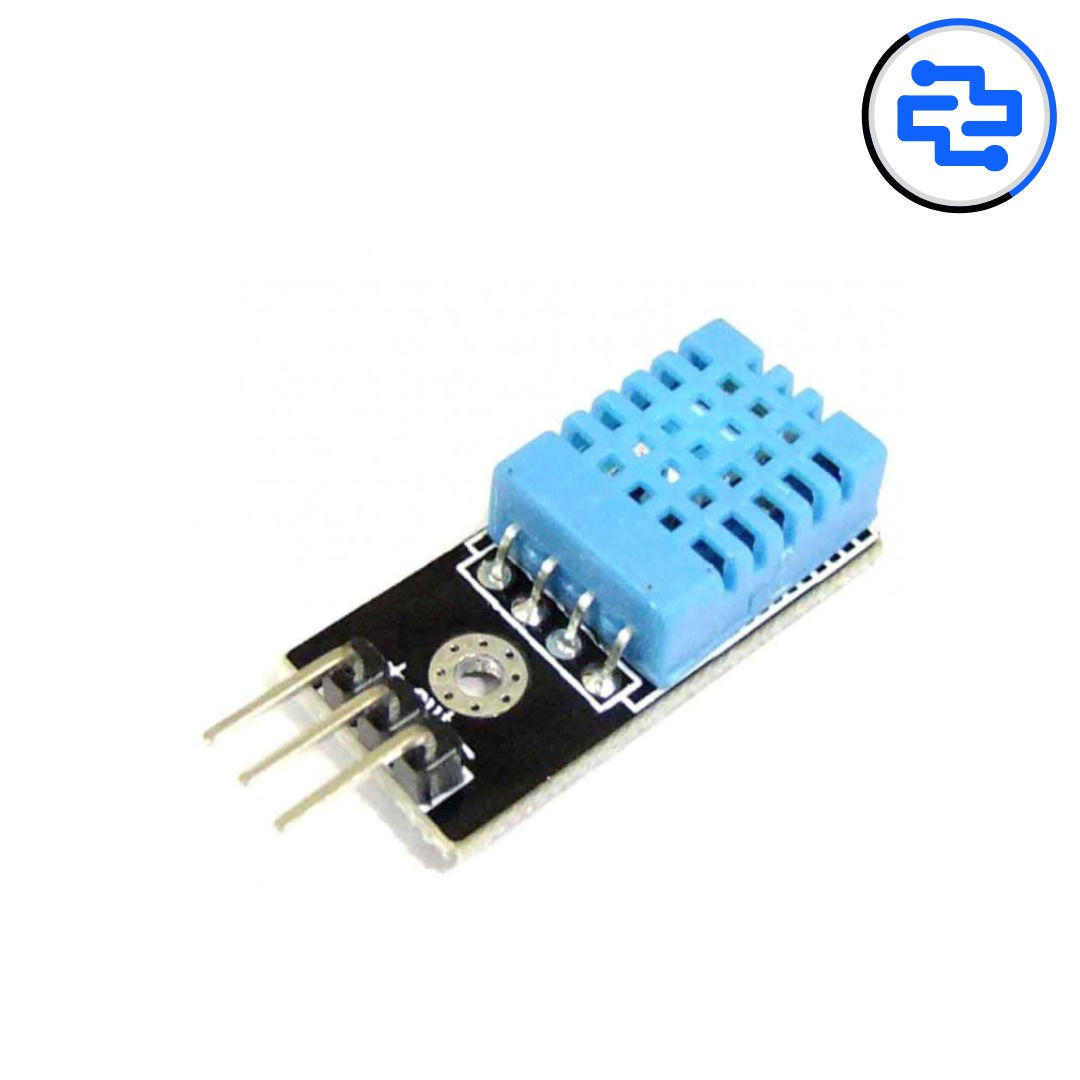
DHT11 Humidity and Temperature Sensor Module
In Stock
₹60.00
(Excl. GST)
BMP180 Digital Barometric Pressure Sensor Module
In Stock
₹70.00
(Excl. GST)
DS18B20 Water Proof Temperature Probe
In Stock
₹92.00
(Excl. GST)
DHT22 Temperature and Humidity Sensor Module
In Stock
₹180.00
(Excl. GST)


BMP280 Barometric Pressure and Altitude Sensor
In Stock
₹50.00
(Excl. GST)
BME280 Temperature Sensor Module
In Stock
₹150.00
(Excl. GST)